Taste Engine Optimization
How algorithms are impacting how we cook and eat (Part 1)

Simply the best
Have you ever noticed how so many online recipes have hyperbolic or superlative titles, like The BEST Chocolate Chip Cookie You’ve Ever Tasted or The Ultimate Palak Paneer? This is, in part, the effect of Google’s PageRank algorithm, a series of data computations that have shaped our world for the past 27 years. Developed by Google’s founders Larry Page and Sergei Brin, the algorithm builds upon a long history of mathematical models for scoring and predicting data positions within networks. However, once it was released onto the world wide web, PageRank began to exert an unprecedented force on us and our attempts to connect with one another. Companies and creators have poured billions into developing strategies for Search Engine Optimization, commonly referred to as SEO, to play PageRank to their advantage and rank higher on Google’s search results.
As it turns out, keywords are critical. In today’s landscape of online recipes, thanks to the SEO imperative, desirable culinary attributes are rendered into keywords appended endlessly into a title until it begins to look like a German noun. If you want not only a chocolate chip cookie, but one with chewy middle, crispy edges— oh, and gluten-free and vegan? Well, you’ll find at least 12,337 search results for recipes titled “The Best Ever Gooey-Inside Crispy-Edged Vegan Gluten-Free Chocolate Chip Cookies”. The system, it would seem, works!
The SEOptimizied recipe titles are at once hyper specific and extremely generic, which both serve the pragmatic function of optimizing their retrieval by the algorithm. But by the logic of PageRank, there is a feedback loop: the more highly ranked a recipe is, the more people see it, the higher it gets ranked1. So, in a way, if a recipe that says The BEST Chocolate Chip Cookies is indeed at the top of the page rank, according to Google’s metrics, it really IS the best— piece of data, that is; the resulting cookies are secondary or dependent.
This all begs the question: what is being optimized here, the recipe itself or its data ranking? While the designers of PageRank would certainly say both— that the quality of a recipe as made by real-world users will increase its impressions and shares, the number of times it gets linked to— the main determinant of the algorithm— it is worth prizing these two objects apart.
For one, as journalist Kyle Chayka argues in his 2024 book Filterworld: How Algorithms Flattened Culture, the SEO imperative has a flattening effect on the range, diversity and originality of cultural production online. He explains:
“By flatness I mean homogenization but also a reduction into simplicity: the least ambiguous, least disruptive, and perhaps least meaningful pieces of culture are promoted the most. Flatness is the lowest common denominator, an averageness that has never been the marker of humanity’s proudest cultural creations” (9)
In other words, the SEO feedback loop doesn’t only reinforce and amplify popularity and unpopularity, it flattens— smushing all the various dishes of the internet around on the algorithmic dinner plate until it becomes a homogenous mush. Over time, this informs what even ends up on the internet in the first place: we start making mush to begin with. Why? Because mush is the algorithm’s favourite food.
And even though we’re feeding the algorithm this flattened mush in hopes of achieving better page ranking, its effect of course spread quickly into the offline world, impacting material things ranging from agricultural markets and supply chains to our own bodies and— as is today’s topic— food preferences and cooking styles. So, how is algorithmic optimization impacting how we cook and eat? And, how are the benchmarks for culinary optimization shaped by the context of internet-fuelled hyper-capitalism that has begotten these algorithms in the first place? These are the topics of inquiry for today, which have by now gotten rangy enough to warrant a Part 2 next time. Thank you for joining me.
But what are we prepping FOR?
Recipes themselves are not unlike algorithms; they are set sequences of actions that produce a pre-determined output. Recipes have also always been about optimizing in a sense: making the most of a combination of ingredients, whether to attain the best value, the most deliciousness, the highest nutrition, et cetera. But until the arrival of mass media and the internet, the standards by which ‘the best’ was judged were constrained and context-specific. This resulted in something of a pluriverse of recipes designed to adapt to constraints such as what one had on hand, or idiosyncratic taste. This is why old family recipes today appear as weird delights: great aunt Enid put sultanas in her chicken à la king and now her kids and even their kids prefer it that way. This would never fly on the internet; I can imagine the snide recipe comments already.
But today, you and I have access to millions and millions of online recipes, and so it makes sense that the task at hand is to winnow them down to only the best. This “besting” is a matter of science, both culinary and information. Thousands of chefs, home cooks and online foodie content creators have set to work debunking bad techniques2, perfecting or innovating said techniques, and cross-pollinating methods and ingredients. SEO and social media algorithms collaborate to spread improvements around the internet and deposit them at the top of our feeds—a term that here doubles with the appropriate sense of being force-fed like a foie gras duck: free to consume our fill, but not to our ultimate benefit.
Some of this algorithmic funnel-feeding has led to positive outcomes. Anyone who grew up being subjected to bitter, mushy boiled Brussels sprouts can attest to their undeniable improvement when deeply roasted— a method popularized by American chef David Chang in the early 2000s and which then spread like wildfire around the internet, becoming the standard method of preparation in restaurants. This example, however, obscures the many subjective assumptions beneath an optimize-y phrase like “the best”. The best according to what, exactly?
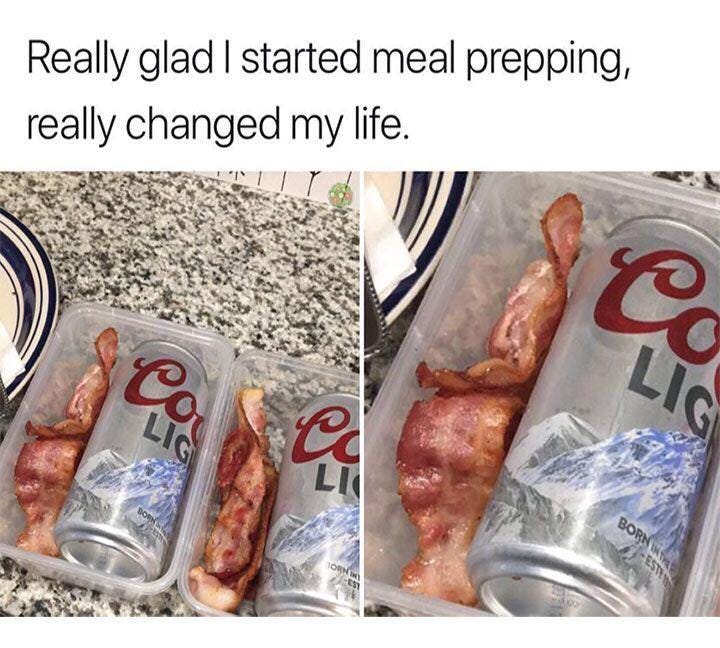
For a recipe like cookies, it is often tied to mouthfeel or texture: optimizing for chewiness, crunch, tenderness, et cetera. But perhaps the prevailing imperative I’ve noticed more generally in algorithmic recipe optimization is signalled by the emergent strand of home cooking known across the internet as “meal prep”. To meal prep is to assemble en masse and then refrigerate or freeze multiple, identical, pre-portioned meals that appear to be the lovechild between a diet concocted by a personal trainer-turned macrobiotic chef in Malibu and a Michelina’s microwave dinner: healthy, repeatable, inoffensive.
These meals (as they are portrayed in the millions of social media videos that feature them) tend to consist of a wholesome and virtuous looking mix of whole grains, colourful vegetables, and satisfying proteins portioned out in multiple aesthetically appealing and uniform glass containers. While they are made ahead and microwaved later, everything about their aesthetic screams they are not leftovers. Rather, they represent the dual consumer fantasies of mass production and idealized consumption in our own kitchens. Time-saving and healthy3— these are the values meal prep promises.
But meal prep is more than gentrified leftovers. My sense is that it has evinced a distinction between cooking— that non-quantifiable end-product of the cultural practice captured in its name— and meals, alimentary inputs that are frictionless and pleasant to consume, and again, ‘healthy’ or time-saving. This distinction feels very now, very hyper-capitalist. It demonstrates, I think how the algorithm is teaching us to make day-to-day, personal decisions like corporations, weighing cost, benefit; input, output. In fact, in Filterworld, Chayka uses industrial food production as a metaphor for algorithms, writing “how the Facebook feed works is a commercial decision, the same as a food manufacturer deciding which ingredients to use.” (20).4 As a genuine food lover, this makes me cringe.
And this is to say nothing of the flavour! Meal prep also takes the industrial food industry’s approach to reducing entire cuisines down to a few derivative flavour signifiers to be added on in the form of “sauce” or “seasoning” to components like “grain”, “protein”, and “vegetables”. Based on my research into meal prep recipes, a standard line-up of prepped meals might include such multicultural offerings as “taco/burrito bowl” or a “pad thai bowl” or a “butter chicken bowl”. (Why is everything a goddamn bowl?) Meal prep is Filterworld’s answer to home cooking: insipid and average, culturally flattened and made into mush through endless algorithmic remixing, and yet still some how able to claim “the best” in a flaccidly optimistic way.
Though, by now, I am sure you can see that I am disdainful of meal prep, I don’t necessarily disparage meal preppers. Meal prepping makes sense for us as time-starved worker-consumers of late capitalism who are saturated in wellness discourse and terrorized with the compulsion to self-optimize in every possible way. Meal prep could also be seen as a downstream consequence of second wave feminism5, in which fewer households have a stay-at-home mom doing unpaid home cooking every night. Either way, it does make sense for where we are culturally and economically.
But I do wonder what meal prep augurs for the future of cooking and eating. The ingredients and techniques that we treat so interchangeably (à la ‘the bowl’) were not invented by recipe bloggers; they come from millennia of domestic cultural production around the world. But unlike really good (or even just ok) home cooking, I’d go so far as to argue that, on the whole, meal prep is not cuisine. It is alimentation: edible inputs that we call meals the same way canned dog food is a meal for your dog.
New difficulties
One of the key effects of Filterworld that Chayka points out is the heavy selection pressure of the aesthetic quality of inoffensiveness. Whether for food, art, music, or literature, the primacy of inoffensiveness challenges an important factor in the development of taste, which is difficulty. Taste, according to Taste Guy™ Pierre Bourdieu6 is a social process concerned with status, which is accorded based on the cultural significance of the products consumed. Learning to love difficult-to-read literature, or eating difficult foods— the ones that we don’t like at first bite— says Bourdieu, is central to the process of taste-making, which in turn serves what he calls distinction: the act of coming to belong to, or to set one’s self apart from, a group of people through our tastes.
On the belonging side for example, in places where very spicy foods are eaten regularly, children come to like these foods by watching older people eat them and connecting this act to group belonging7. The same goes for bitter foods like coffee or tea, and — for slightly different reasons— cultured, fermented, rotted, and aged foods. On the setting apart side, the epitome of haute cuisine, at least to the North American sensibility, used to be French food, whose difficulty was a central part of the appeal: escargots! capers! tripe! The principle of acquired taste served as a natural barrier to gaining the cultural capital associated with these foods, and thus preserving their elitism8. Either way, difficulty is key.
But with hyper-capitalism and increased access to recipes and ingredients, some of these barriers have fallen. Metropolitans around the world can graze from a buffet of global cuisines in a day; no longer restricted to regional or commodity foods, our buds have been exposed to an array of flavours and as a consequence our palates have expanded.
In short, it would appear that many people (Westerners mostly) have acquired more taste than ever before in history. But the word acquire— to gain possession of— is apt, for it also captures the political-economic bases of such culinary globalization, namely colonization and imperialism. The theft and acquisition of recipes, now remixed into a mush of fungible constituents is one direct legacy of globalization. However, as Gayatri Spivak writes, “globalization takes place only in capital and data. Everything else is damage control.” In other words, it’s only the platforms and tech companies making us jump through algorithmic hoops that are benefitting from this. Meanwhile, that we have grown an insatiable taste for the mush is the damage that we are left to contend with— inequitably, I might add.
Racialized chefs understand this gastronomic inequity better than anyone. Chef and writer Jenny Dorsey writes how her traditional Chinese lunches packed by her parents were perceived as “disgusting” by other students, and later, in culinary school, how Chinese pantry staples like Shaoxing wine were brushed off as interchangeable with Sherry by her instructors who, at the same time, waxed poetic about the nuances between different milks produced on two sides of the Rhône. The question Dorsey is posing here is: whose taste has the power to be constructed as good or neutral? And I wonder, for the sake of our inquiry today, where does this leave the flavours, textures, and ingredients that are too difficult to incorporate into the algorithmic mush?
Dorsey centres these questions when she asks her her dining guests to confront their own discomfort at the racial histories of taste and culinary preferences that are often unspoken around in discussions of culinary difficulty. In a supper club menu designed around the theme of radical honesty, Dorsey describes a dish based on her feelings of shame around her school lunches:
“The dish is my interpretation of shame, I explain, dovetailing with my visceral feeling of disgust at our imprinted cultural hierarchies of which foods matter, which do not. The servers bring out metal lunch boxes, two at a time, and arrange them on the table as plates. Inside, each one bears a sticker that reads: “HELLO MY NAME IS: Disgusting!” The dish uses many of the ingredients I once frantically dissociated myself from, now gentrified into something clever and expensive. Garlic chives, an ingredient often punitively described as smelling like farts, now generally regarded as the secret to Chinese cooking; freshwater eel with its brick-red veins but no sweet soy to mask its robust flavor. They are accompanied by a mound of white snow fungus, coated in a thick green emulsion of duck tongue and peanuts, propping up toasted silkworm larvae. Entomophagy (eating insects) is so gross, yet so sustainable — a nightmare for the woke but privileged.”
By eliciting their discomfort, Dorsey reveals the pandering to Western taste norms that self-proclaimed adventurous— “woke but privileged”— foodies nonetheless expect. And in doing so, I would argue that Dorsey is enacting what political scientist Cathy Cohen calls “deviance as resistance” which Kyla Wazana Tompkins9 writes, “seeks to make visible the deep structures of normative judgement”10. Tompkins argues that repeated acts of deviance like this can accumulate over time and shift or challenge power relations— in this case, the racialized and capitalist power relations that construct the neutrality of the taste of our algorithmic mush. Though she does not frame it in these terms, I see Dorsey’s work as a counterforce against the flattening and extractive forces of SEO on food, culture, recipes, and taste.

What we have been getting to today, in an admittedly roundabout way, is that through our tastes (and what we taste), we reproduce and make distinct our identities. We have so far contended with the fact that the flatness of the taste produced by the logics of filterworld is not neutral; that there are preferences that dominate through algorithmic optimization and that these preferences follow lines of power; and, that some tastes— like the dishes Dorsey served are, in fact, too “difficult” (or, as I propose, deviant) to be included in the data set.
So, what can difficulty, in its deviant sense, do? This leads us into the conclusion of Part 1 of this essay, and sets us up for Part 2, which is a deeper exploration of taste, difficulty, and deviance — as offering aesthetic and political modes of resistance to the imperatives of Filterworld. Part 2 will ask, what if more restaurants and chefs and home cooks (and meal preppers) did what Dorsey did? It will also explore the affective roots of optimism in optimization, and propose, following writers and critics like Dorsey, Tompkins, Cohen, Chayka, and others, that there is perhaps strategic value in rejecting optimism for something with more teeth, and even more guts. The future of food perhaps would be better off for it.
See you next time.
“Under algorithmic feeds, the popular becomes more popular, and the obscure becomes even less visible.”(Chayka, 37)
Harold McGee’s decades-spanning column, The Curious Cook, in the NYT stands out in my mind as an unparalleled contributor to technique refining and debunking — yes, before the internet.
Within these values lurk the ever-present shadow of diet culture: stay on top of your clean-eating and protein goals by having a steady stream of ‘healthy’ temptation-busters in your freezer. I talk about this more centrally in my essay on protein.
The industrial (junk) food sector has long been about maximizing/ optimizing tastiness in a nearly perfect algorithmic way to sell packaged food. Mark Schatzker argues in his 2015 book The Dorito Effect that industrially produced snack foods are designed to optimize for the brain-chemical-boosting flavour compounds that create addictive behaviours.
And very much deserving of all the same critiques of second wave feminism in its lack of intersectionality and class, race, power analysis— meal prepping is still fairly bourgeoise.
Pierre Bourdieu. Distinction: A Critical Judgement on Taste (1979)
Psychologists Paul Rozin and April Fallon discuss the distinction between the innate distaste for bitter and spicy foods and the cultural distaste for some rotten or fermented foods in their now-foundational work on the social nature of disgust in the 1980s. They emphasize the overlap and interplay between social and innate drivers of taste: “Social factors, however, may be more important in the acquisition of liking for chili pepper. A study in a Mexican village suggests that chili eating is not explicitly rewarded, but is acquired in a social context where respected adults and older children eat and enjoy it (Rozin and Schiller, 1980).” Read the quoted paper, here.
Cultural capital is another concept from Pierre Bourdieu. Chayka discusses the work of scholar Kate Eichorn who uses the term “content capital” to explain how personal brand is now the be-all-and-end-all that drives cultural influence and success (164). This might go some way in explaining the shift away from Bourdieu’s cultural capital— acquired through the development of personal taste and discernment which involves at least in part, an appreciation for difficulty— and towards the more business-minded, corner-cutting ethos of content capital.
In my favourite book of 2025, Deviant Matter: Ferments, Intoxicants, Jelly, Rot.
Deviant Matter (2025). Kyla Wazana Tompkins. p. 26